Tech Hiring Strategy: The Rise of Skills‑Based Assessments

The rules of tech hiring are being rewritten — and what worked yesterday just doesn’t cut it anymore.
In a competitive talent acquisition landscape where companies battle for top software developers and engineering talent, traditional signals like degrees and job titles are losing their predictive power. Skills‑based hiring, backed by practical skill assessments and data‑driven recruitment tools, is now powering smarter decisions and stronger tech hiring strategies.
But what exactly makes this shift so powerful — and why are leading HR teams and developer recruiting platforms racing to adopt it?
Let's break down the rise of skills‑based assessments, reveal why they’re reshaping the future of recruitment, and show how you can transform your hiring process for better performance and faster results.
What Are Skill‑Based Assessments?
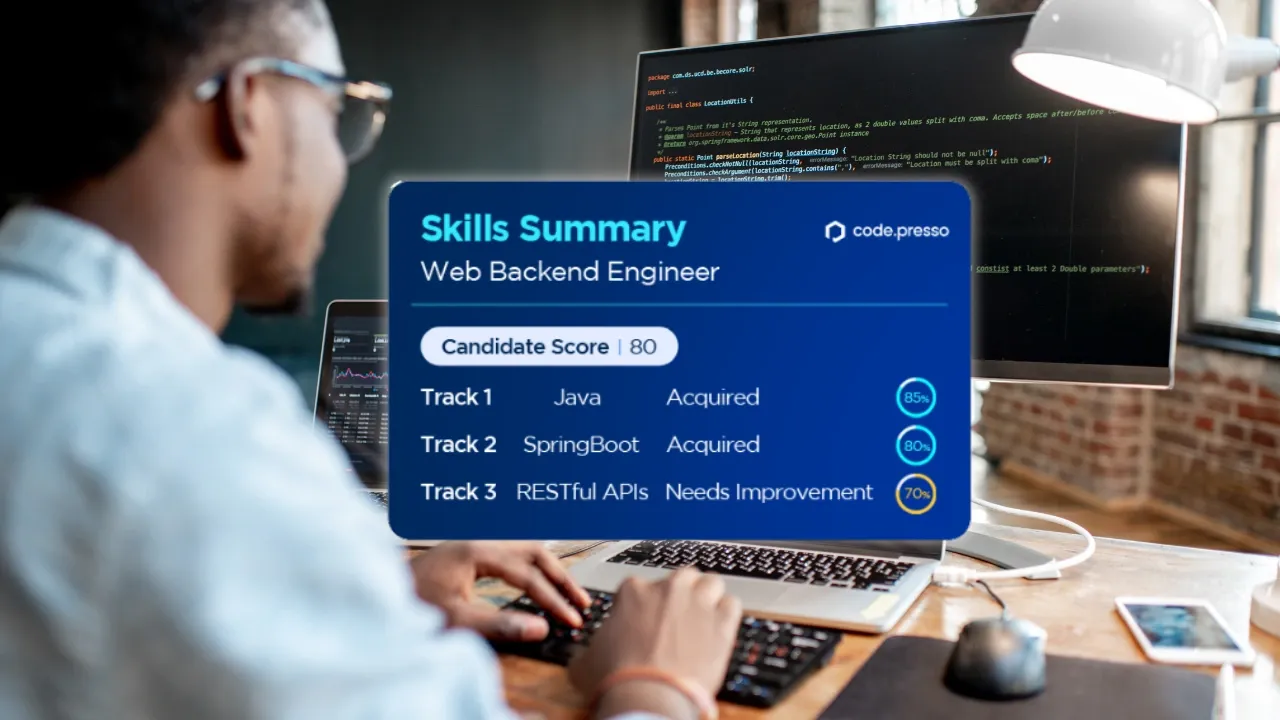
Skill-based assessments are structured evaluations where candidates demonstrate job-relevant competencies through real-world or simulated tasks, such as:
- Solving algorithmic challenges or debugging code
- Designing scalable system architectures
- Building APIs, data pipelines, or production-ready modules
- Collaborating in virtual environments (code review, pair programming, etc.)
This approach emphasizes actual proficiency over pedigree, enabling companies to make more informed, evidence-based hiring decisions.
How They Differ from Traditional Credential-Based Hiring
| Hiring Approach | Description |
|---|---|
| Credential-Based Hiring | Focuses on academic degrees, years of experience, and prior employers. |
| Skill-Based Hiring | Evaluates tangible capabilities via hands-on tasks, practical challenges, and contextual simulations. |
- Credential-Based Hiring focuses on academic degrees, years of experience, and prior employers.
- Skill-Based Hiring evaluates tangible capabilities via hands-on tasks, practical challenges, and contextual simulations.
By shifting the focus to performance, organizations can confidently assess candidates who have developed skills through non-traditional paths — including bootcamps, self-guided learning, open-source projects, or in-role training.
Why Skill-Based Assessments Are Transforming Tech Hiring

1. Expanding Access to Diverse and Untapped Talent
Evaluating skill over credentials allows companies to attract a broader and more diverse candidate pool, including self-taught developers, career changers, and underrepresented groups — driving innovation and inclusion.
2. Improving Hiring Accuracy and Reducing Risk
Skill‑based assessments allow recruiters and hiring managers to test candidates against the actual job requirements — not theoretical credentials. This leads to more accurate evaluation of technical competence, reducing the risk of hiring someone who looks good on paper but can’t deliver the work.
Some research backs this up: skills-oriented hiring reportedly leads to better job performance and fewer mis‑hires than traditional credential‑based hiring.
3. Accelerating the Recruitment Cycle
Skill‑based assessments can significantly reduce the time spent on resume screening and multiple interview rounds. By eliminating early‑stage guesswork, teams can quickly zero in on candidates who demonstrate real potential — accelerating hiring cycles and allowing companies to fill roles faster.
4. Enabling Objective, Bias-Resistant Decision-Making
Relying on credentials often perpetuates bias — favoring those from elite universities or certain career backgrounds. By evaluating concrete skills and performance, skill‑based assessments promote fairness, inclusion, and meritocracy, enabling a more equitable hiring process.
5. Future-Proofing Talent Acquisition Strategies
In a fast-evolving tech landscape, what matters today may be obsolete tomorrow. Skill‑based hiring enables organizations to align recruitment with current business needs and future demands — hiring for agility, adaptability, and actual competence rather than credentials alone.
Leading Platforms & Solutions for Skill‑Based Tech Hiring
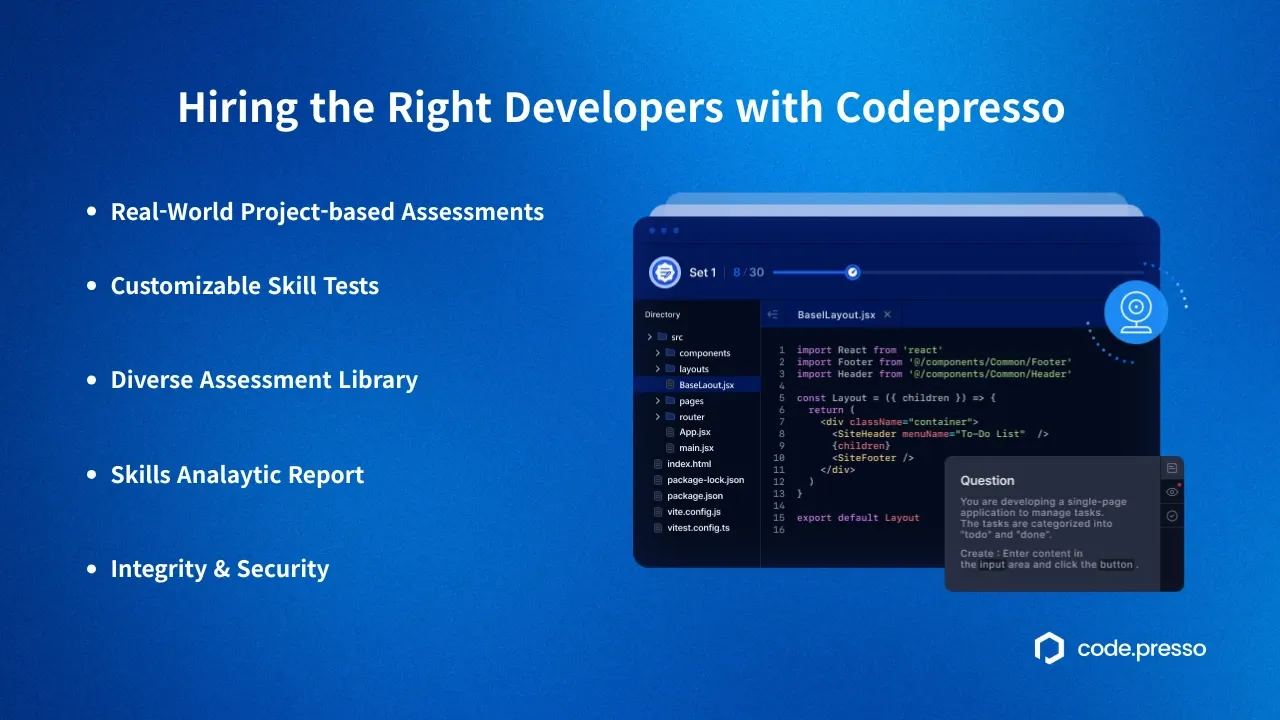
Scaling a skills-first hiring model requires the right tools. Here’s a look at leading platforms empowering tech teams to assess, screen, and hire based on actual ability.
Codepresso focuses on real-world, project-based assessments designed to measure practical developer ability across 50+ job roles (AI, Data, Web, Cloud, Security, etc.).
- Tests simulate actual development tasks (API building, DB integration, debugging, AI modeling).
- Provides detailed skill analytics, code quality insights, and structured feedback.
- Suitable for hiring, upskilling, and organization-wide skill benchmarking.
- Strong anti-cheating & remote proctoring.
Best for: Companies seeking evidence-based, practical, and role-specific evaluation — not just coding puzzles.
HackerRank supports broad technical hiring needs with its vast library of coding problems, project-based tasks, and technical interview capabilities.
- Supports 20+ developer roles and frameworks
- Integrated coding challenges, SQL/DevOps tasks, and live pair-programming
- Full-stack platform for both screening and interviewing
Best For: Large organizations managing high-volume hiring pipelines or multi-role technical evaluations.
Codility offers a streamlined, algorithm-focused assessment solution for early-stage screening and developer vetting.
- Automated grading of core programming challenges
- Clean UI and intuitive candidate experience
- Ideal for filtering candidates in the early stages of the funnel
Best for: Companies seeking a lightweight, scalable screening tool to efficiently evaluate basic programming aptitude.
Quick Comparison Recap
- Codepresso (SkillCertify): Deep, real-world project-based assessments for practical job-ready skills
- HackerRank: Broad technical hiring platform.
- Codility: Speed and simplicity for pre-interview screening

Final Thought
The growing adoption of skill-based assessments marks a pivotal shift in tech recruitment — one where capability trumps credentials. In an era where innovation hinges on agility, creativity, and execution, organizations must evaluate talent through the lens of what candidates can actually do.
Forward-looking companies like Codepresso are leading the charge, using performance-driven evaluations to build high-impact teams, reduce hiring risk, and unlock access to global talent.
As the tech industry continues to evolve, a skills-first hiring strategy will no longer be a competitive edge — it will be a business imperative.




Comments ()